Parts of a Suspension System: A Tech's Breakdown
Date Published
You hit an expansion joint on I-35E at 70 mph in a stock 2021 F-150. If you do not lose your teeth or bounce into the next lane, thank the metal and fluid doing the heavy lifting under your chassis. Most drivers only think about the parts of a suspension system when the underside of their vehicle starts making a clunking noise or rides like a brick.
TL;DR: The parts of a suspension system work together to absorb road impacts, support vehicle weight, and keep your tires planted firmly on the pavement.
- Springs hold the vehicle up and absorb the initial shock of a bump.
- Shocks and struts control the spring's movement so the vehicle does not bounce uncontrollably.
What Parts of a Suspension System Actually Are
The system is a network of load-bearing components and linkages connecting a vehicle to its wheels. We view it as the mechanical bridge between the frame and the road surface. Without these parts, rigid axles would transfer every ounce of impact force directly into the cabin and frame.
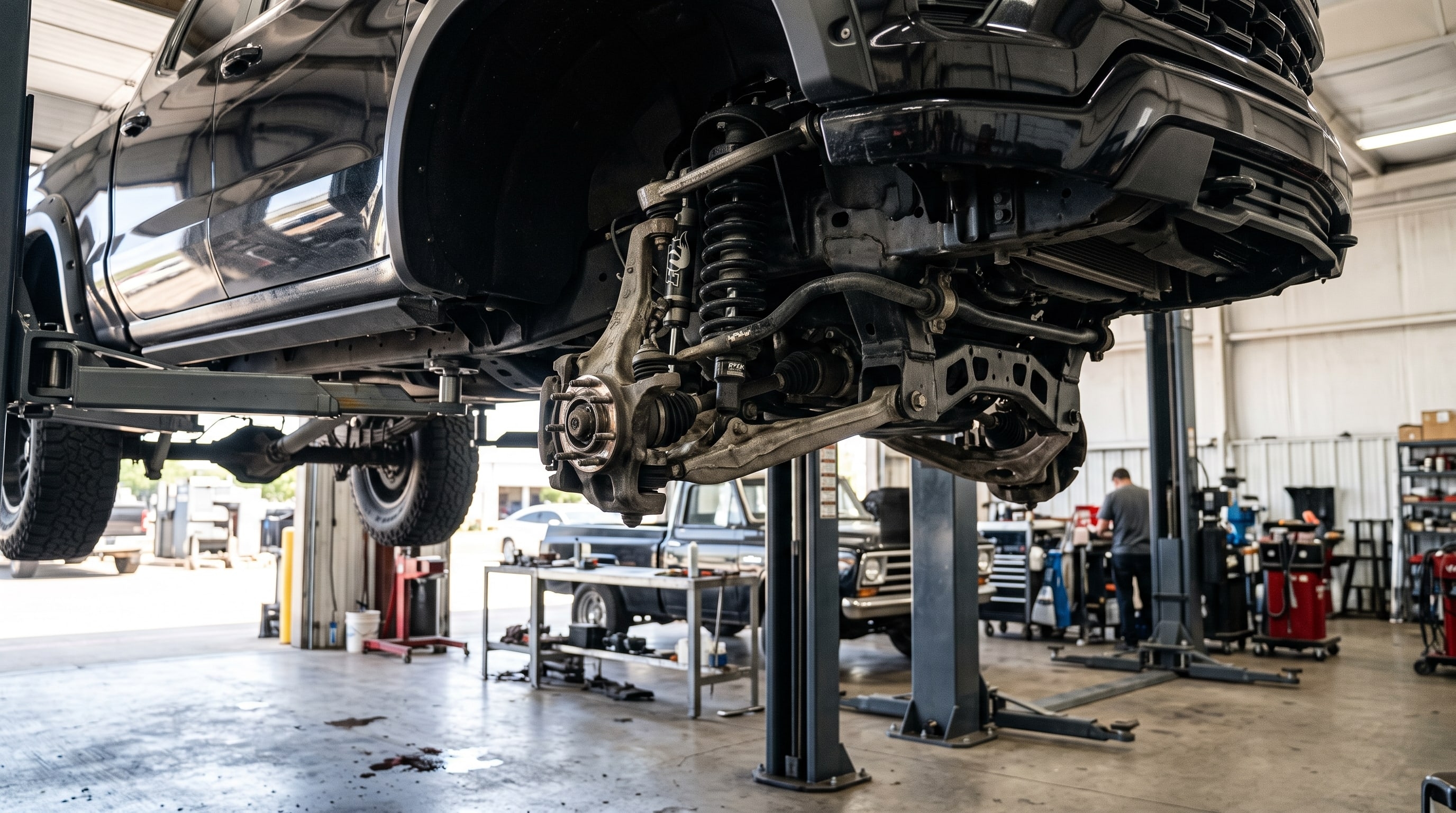
Think about a 2024 Silverado 1500 rolling into our shop for a truck suspension upgrade. The factory setup includes upper and lower control arms, coil springs, shock absorbers, and a sway bar. Each piece handles a specific direction of force to keep the heavy steel body stable while the heavy wheels move up and down over uneven pavement.
How It Works
The process starts the millisecond a tire hits a pothole. The wheel is forced upward, which compresses the spring. The spring takes the physical energy of that impact and stores it, preventing the jolt from transferring directly into the cabin.
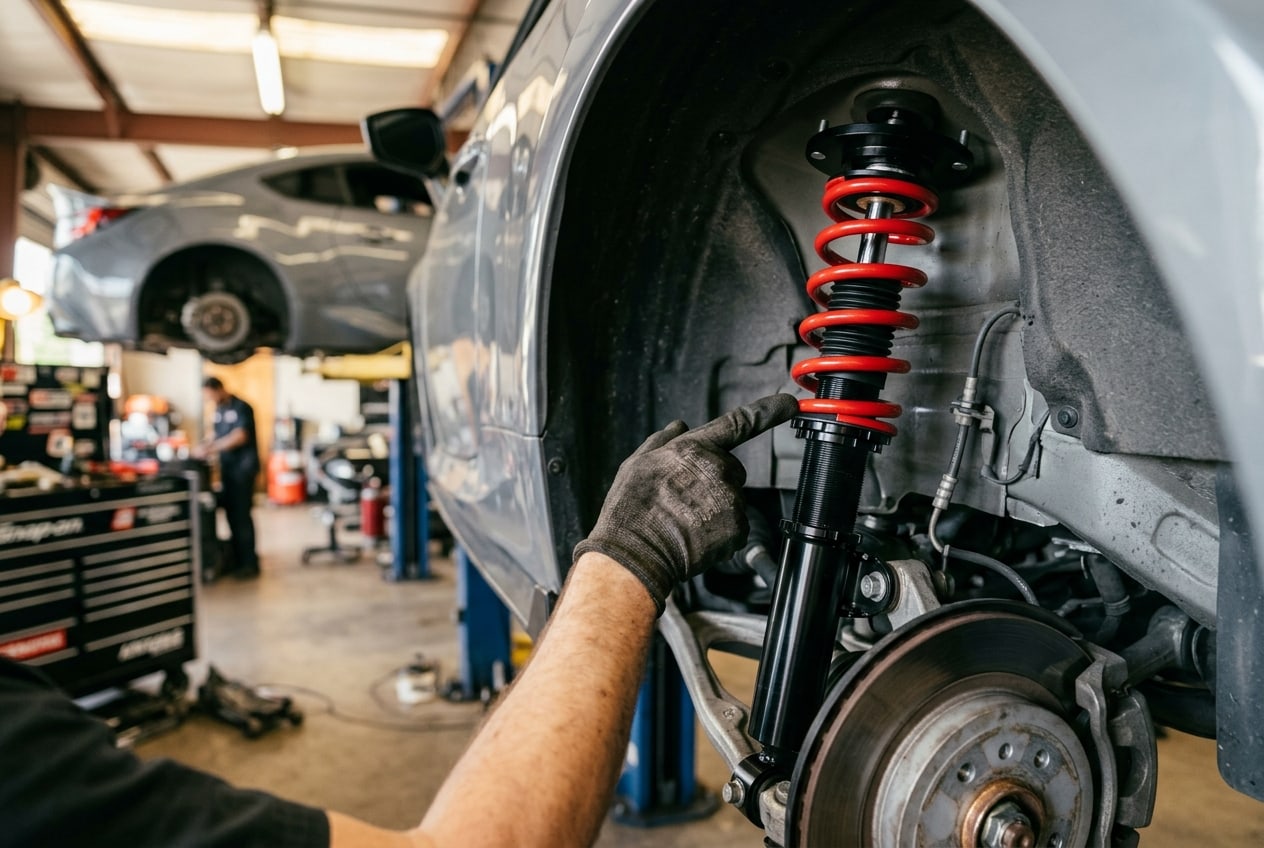
A compressed spring wants to rebound rapidly. This is where the shock absorber steps in. Shocks are filled with oil and sometimes pressurized nitrogen gas. A piston pushes through that fluid, creating hydraulic resistance that slows down the spring's bounce.
Linkages and joints keep everything aligned during this chaotic movement. Control arms act like hinges, allowing the wheel assembly to move vertically without shifting forward or backward. Ball joints serve as pivot points so the front wheels can turn left and right while simultaneously moving up and down.
Sway bars tie the left and right sides of the vehicle together. When you take a hard corner on the George Bush Turnpike, the vehicle naturally wants to lean outward. The sway bar twists to resist that body roll, keeping the inside tire planted on the asphalt. Our team in Irving handles these setups daily, ensuring every car suspension service leaves the vehicle tracking perfectly straight.
Why This Matters
A failing component does more than make your commute uncomfortable. Worn shocks increase your braking distance by up to 10 feet from highway speeds because the tires bounce off the road surface during hard stops. Bad ball joints cause uneven tire wear, forcing you to replace expensive rubber long before the tread should actually wear out.
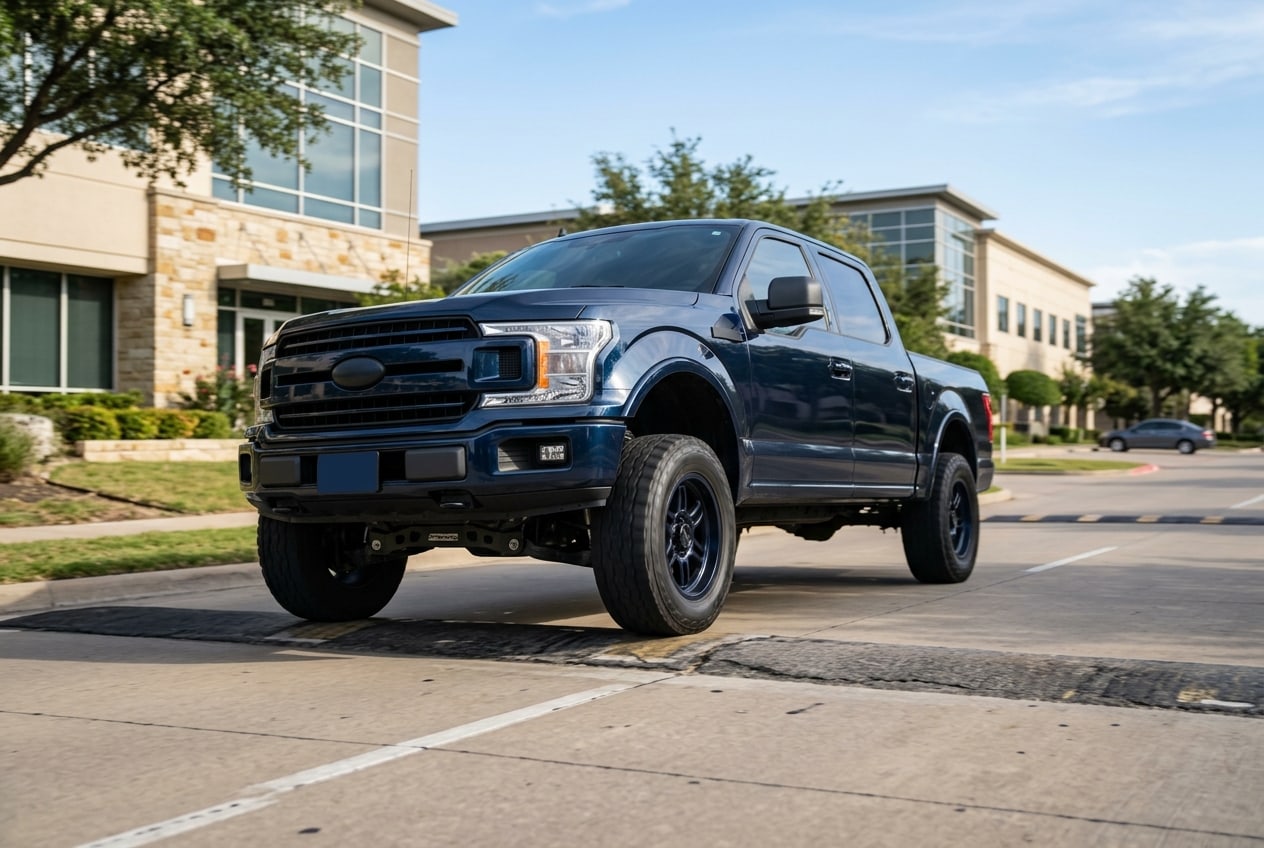
Upgrading these parts changes the entire capability of a vehicle. Swapping factory struts for a set of BC Racing coilovers or a Rough Country lift kit alters the geometry to handle heavier wheels, higher speeds, or aggressive off-road trails. If you are swapping out your custom wheels and tires, you need the right suspension clearance to match.
Common Misconceptions
- Myth: Shocks support the weight of the vehicle. Springs support the weight, while shocks only control the speed of the spring's movement.
- Myth: A stiffer suspension always handles better. Overly stiff parts on rough roads cause tires to skip and lose traction, reducing actual grip.
- Myth: Struts and shocks are the exact same thing. A strut is a structural part of the suspension that holds the spring and replaces the upper control arm, while a shock is just an independent dampening cylinder.
Frequently Asked Questions
How much does it cost to replace suspension parts?
Prices depend heavily on the make and model. A basic strut replacement on a daily driver runs $600 to $900, while a full heavy-duty lift kit installation exceeds $2,500.
How do I know if my suspension is failing?
Watch for a vehicle that continues to bounce after hitting a bump, uneven tire wear, or a visible fluid leak running down the side of a shock absorber. Clunking noises over speed bumps also indicate worn bushings or ball joints.
How long do factory shocks and struts last?
Most factory dampeners begin losing their effectiveness around 50,000 miles. Texas summer heat and rough construction zones accelerate this wear, causing the hydraulic seals to dry out and fail prematurely.
Metroplex Customs — Irving, TX
325 S Belt Line Rd, Irving, TX 75060
Call (972) 399-0378 — Fixing Rides Since 2016. Ask about Acima no-credit-needed financing.
Get My Free QuoteComments
No comments yet. Be the first to comment!